

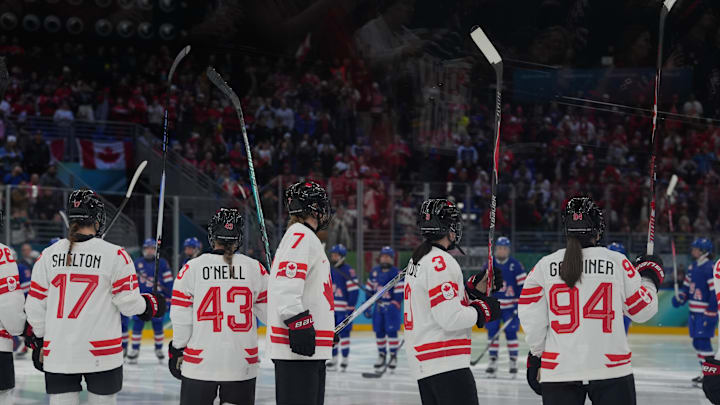
At this point in the Canada-United States hockey rivalry, it's clearly the Americans who have the upper hand.
With the United States' triumph in last Thursday's gold medal game in the history books, which was a 2-1 overtime decision, each of the last eight games played between the Canadian and American women have gone the way of the United States. That ongoing run is equal to the one the United States put together in the eight head-to-head matchups leading up to the 2002 Winter Olympics.
In a holistic sense, the Americans are also enjoying their most dominant run of form in program history. Not only did they win all seven of their games at the Winter Olympics, but they also conceded just two goals over that span.
And the Americans did it with a roster that has an average age of just 25.91 years. Of the 23 women that comprised the United States' entry, just six were at least 30 years old. Meanwhile, over half the roster was 25 years old or younger.
As for the Canadians, they entered the tournament with twelve players over the age of 30, four of which are in a position where they could have easily played their last Olympics. Just five players were 25 years old or younger heading into the Olympics.
The very-apparent age differences between the two rosters was also on display in their two matchups. Despite Canada's ability to put offensive pressure on the Americans, the United States looked a lot faster and a lot more potent in all facets of the game.
If Canada wants to reassert themselves as the top dogs of the women's game, they have to act fast. The 2026 edition of the Women's World Championship is set to take place in early November, and the Rivalry Series will also serve as a means for these two nations to play against each other.
Though the Rivalry Series doesn't have firm dates yet for the 2026-27 campaign, it's practically a certainty that Canada and the United States will play each other in some form at the Women's World Championship.
So how does Canada build a roster equipped to take on the United States?
That's easy. Just do what the Americans did and get younger.
Yes, I'm aware that even when considering the fact that Canada's squad is much older than that of the United States, they're nonetheless a significant favourite to go all the way and win a tournament. Though the rest of the world is making progress, Canada is still a force to be reckoned with when it comes to hockey, especially the women's game.
But if Canada is to reclaim their spot on top of the women's hockey world, they have to put themselves in position to beat the team on top.
That means ensuring that a lot more of their roster is made up of players under 25 and that there is an even balance between young stars and veterans.
The best way to do that? Looking at the collegiate level.
The United States' 2026 Olympic roster had six players enrolled in NCAA hockey programs, including the University of Wisconsin's Laila Edwards. In an Olympic tournament that represented her fourth international appearance for the United States, Laila Edwards recorded eight points (two goals and six assists) in seven games. The Olympics also represented the third tournament where she's recorded eight points, with the other two tournaments being the 2022 U18 Women's World Championship and the 2025 Women's World Championship.
While the bulk of the PWHL's draft-eligible players are American, most of them play in collegiate hockey programs. Brooke Disher (Ohio State) is one of Canada's top-ranked PWHL prospects, but it's worth taking note of players like Jessymaude Drapeau, who plays her hockey for U Sports' Concordia Stingers. U Sports has largely been overlooked when it comes to professional women's hockey, and these next few years could serve as an opportunity for Canada to scout the nation's collegiate leagues and keep tabs on players like Drapeau.
Not only that, but Jessymaude Drapeau could also find success in the PWHL. Despite being projected by The Hockey News as a tryout/late-round pick, she does have thirty-nine points through twenty-four regular season games this year with Concordia. And through her five-year career with Concordia, she's scored around or above a point-per-game pace, making her an interesting prospect to watch in the lead-up to the PWHL Draft.
We'll know more about her path to a spot in the PWHL as the springtime approaches, but how her Concordia Stingers perform in the RSEQ playoffs (RSEQ serves as Quebec's U Sports subdivision) could very well dictate her place in the PWHL draft rankings. Concordia finished the 2025-26 regular season in dominant fashion, recording a 22-2-0 (wins, losses, ties) record. The Stingers will play McGill in a three-game first round series starting on Thursday, with the winner of the series securing a berth in the RSEQ Championship Round and in March's U Sports National Championship tournament.
A deep run in the postseason for Concordia and a contributing role in such run for Jessymaude Drapeau would all but cement Drapeau as a PWHL draft pick and grant her the opportunity to further prove herself as a dark horse contender for Canada's Women's World Championship roster.
If Canada is to re-establish themselves as a team that can beat the United States in the biggest games, then they need to essentially replicate what the Americans did to build their dominant Olympic roster. Though there will be Canadians picked in higher draft slots, it's players like Jessymaude Drapeau who will act as catalysts for any future international glory for Team Canada.
With the above said, Canada must give players like Drapeau a chance, or else risk a generational fumble.
 Add us as a preferred source on Google