

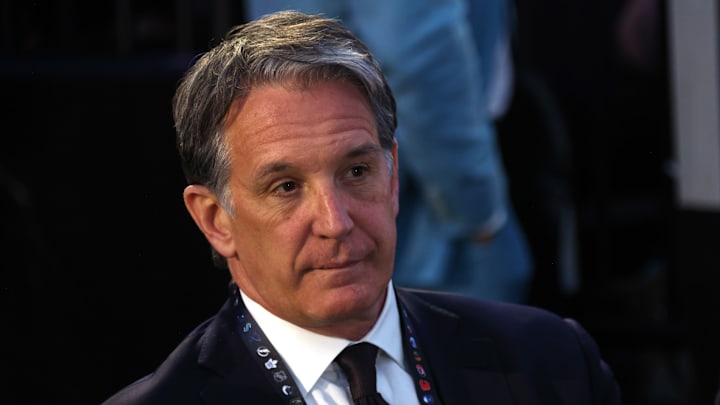
When one thinks of the name Brendan Shanahan, a lot comes to mind. Some people may think of his illustrious playing career, which saw him regarded one of the league's better power play specialists while also winning the King Clancy Memorial Trophy and three Stanley Cups with theDetroit Red Wings.
Others may think of his work in the NHL's front office, specifically with regard to business development and as the league's senior vice president.
And there are those who remember him for his work in bringing the likes of Auston Matthews, William Nylander, and John Tavares to the Toronto Maple Leafs. Some may remember the tragic yet sometimes hilarious collapse of his "Shanaplan."
Now, after a brief stint away from management, Brendan Shanahan is off the job market. But not necessarily in the way you would think.
Just half a year after his contract with the Toronto Maple Leafs expired in the summer of 2025, Brendan Shanahan will be appointed by Hockey Canada to lead a review of men's junior hockey programs in the province of Ontario.
As part of the review, Brendan Shanahan will be reporting directly to three Ontario hockey federations - Hockey East Ontario, Hockey Northwestern Ontario, and the Ontario Hockey Federation - in addition to Hockey Canada's higher-ups.
But while the move is a promising sign for Ontario hockey, it's only coming a little while after the fact that hockey isn't necessarily the most popular sport in Canada became more common knowledge than a rumour. According to a Sports360 study conducted between March and April of 2025, 73% of Canadian youth (ages 3 to 17) were registered in at least one physical activity. 23% of those in that age group were registered in swimming; however, hockey was just the third-most popular option, tied at 10% with basketball. The second-most popular option was soccer at 20%.
It's also worth noting that youth participation in hockey has been on the decline in Canada. According to the CBC, the number of Canadian youth (defined by those 18 or younger) participating in hockey dropped by nearly 200,000 between 2009 and 2022. Those numbers have slightly improved, however that is only part of a trend that has seen a 33% decline in youth participation in hockey, a 15% decline since the start of the COVID-19 pandemic, and a significant rise in youth participating in sports like soccer. Such a sport has gained significant popularity in recent years with the success of the Canadian men's and women's national teams, in addition to that of domestic clubs like the Vancouver Whitecaps.
Speaking of soccer, it's worth noting that the federal government only recently poured well over five-and-a-half billion dollars to invest in the recently-started Northern Super League, Canada's domestic women's soccer league. Not only did the costs of such investment go to supporting the league's inaugural championship game, which saw AFC Toronto take on the Vancouver Rise at Toronto's BMO Field, but it will also go towards improving the league's growth and infrastructure.
Costs of participating in sports can also be seen to play a role in the decline of hockey at the youth level. The same CBC article cited financial concerns as the leading issue regarding parents choosing not to register their kids in hockey; 58% of Canadian parents felt that way as of 2023. The Sports360 survey also reinforces this sentiment; while it didn't point to the cost of participating in each sport, it did determine that parents spent an average of $1,564 per child to take part in sports on an annual basis.
To further reinforce this idea, Hockey Canada itself determined in 2023 that the cost of participating in hockey was on the rise at the vast majority of levels. At the house league level, which focuses more on general participation in the sport, costs have risen to around $1500 per season. But as one goes up to the competitive levels, costs rise significantly, reaching as high as $10000 per player. These costs do not include travelling to games and tournaments or even the costs associated with equipment, which rose well above $1500 in recent years.
And of the four sports where youth registration is the highest, the consensus is that hockey is the most expensive, with RBC estimating the average cost of participating at around $4500 per child. National surveys and organizations have pinned the cost of basketball as ranging between $1000 to $3000, with club level soccer ranging from $1000 to $2500. Meanwhile, Playgroundequipment.com projected that the annual cost of swimming per child is just north of $750.
That's not even considering other factors. Not only is a lack of investment leading to rinks closing or being unable to offer service at given times, but other issues like a reluctance to make a year-round commitment or even an inability to afford all the latest gear can be seen to be top of mind when it comes to participation in the sport.
There is relief though. The NHL and NHLPA launched an initiative called "First Shift", designed to eliminate several barriers keeping kids across Canada from entering the sport. The program's $299 registration fee, which is about less than three times the minimum price of a full season of house league hockey, includes a full set of equipment and expert-led sessions among other benefits.
Canadian hockey teams have also put up strong performances in recent years. Not only did the Connor McDavid-led Edmonton Oilers reach the Stanley Cup Final in 2024 and in 2025, but the Canadian entry in the Four Nations Faceoff ended up taking gold despite finishing second to the United States in round robin play. At the same time, despite losing out on the chance for World Juniors gold once again, Canada has won gold in four of the last nine editions of the tournament.
While Hockey Canada's initial announcement didn't clarify what specifically Brendan Shanahan's review will focus on, they did make four "guiding principles" clear; these include the prioritization of the needs and development of players at all levels, the fostering of collaboration between Canadian hockey's governing bodies and stakeholders in Ontario in order to implement recommendations and reinforce roles and responsibilities, the insurance of transparency at all stages of the review, and the inclusion of Hockey Canada's values into all recommendations and related initiatives.
In my opinion, the principle focusing on the needs and development of players could be where the whole affordability issue can come into play. With costs and inflation hitting and surpassing highs across Canada, many families have found it difficult to justify the high cost of not just registering a child to play hockey, but also to keep them playing the sport throughout their youth.
My hope is that Brendan Shanahan's review recommends policies that ensure low-income families and those that struggle to keep up with the cost of playing hockey can still afford to register their children in hockey leagues. Programs like the "First Shift" initiative should be used as a template for implementing such projects, and they should also ensure that all players regardless of family income or participation level to have a shot at working their way up and earning their chance to excel in the sport.
While Canada is still seen as a powerhouse nation when it comes to hockey, it's clear the competition is catching up. We can see a clear example of this in the form of Czechia's recent run of form against Canada in the World Juniors. Latvia's improved performance against Canada in the same tournament is also nothing to be ignored.
It's not just Czechia and Latvia, though it's worth noting that Czechia's resurgence as a hockey power does come from skill-based development and a focus on the player. The United States' National Team Development Program, operating under the umbrella of USA Hockey, has allowed for prospects to play meaningful hockey and understand what it means to play in top leagues like the NHL; Auston Matthews and Jack Hughes are among the program's alumni.
You want to know what the sad thing is in all this? It's that Canada used to beat opponents like Czechia and Latvia with relative ease.
Now our collective heart rates get raised with relative ease while watching such games.
So whatever Brendan Shanahan is cooking up has to get kids back into the game regardless of external factors. Otherwise, the cost of the sport will continue to balloon, rival nations will continue to catch up to Canada's place in the hockey world, and the sport could end up continuing to decline in Canada.
For Brendan Shanahan, time is of the essence. And for the sake of the country's hockey standing, whatever Shanaplan 2.0 is has to work.
 Add us as a preferred source on Google