

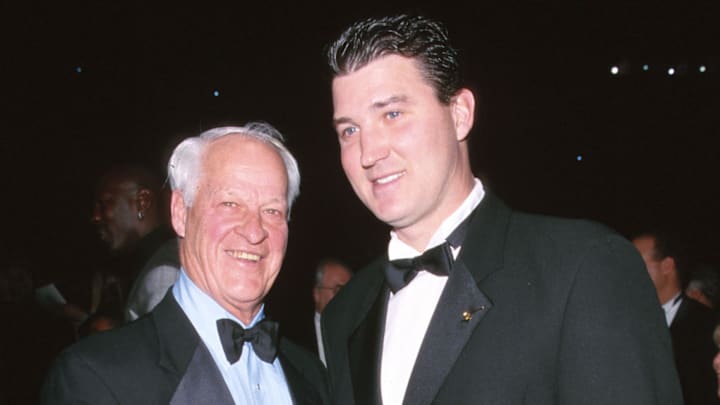
One of the more interesting stories to come out of the world of professional sports this week was Philip Rivers coming out of retirement to sign as a quarterback on the practice squad of the Indianapolis Colts. Rivers retired from the NFL after the 2020 season. He’s 44 years old. He is literally a grandfather. Yet he just signed a professional football contract.
Cool story, right? One of the more interesting tidbits to come out is that Rivers is currently a semifinalist to be inducted into the Pro Football Hall of Fame. If he gets elevated to the active roster for the Colts, he is no longer eligible this year and has to wait another five year (the hall’s standard period of waiting).
The Hockey Hall of Fame has a similar waiting period of a slightly shorter three years. There have been notable exceptions, such as Wayne Gretzky being inducted immediately post retirement, but it got us thinking. Are there any hockey players who returned to the NHL after being inducted into the Hall of Fame?
According to the Hall’s official site there’s a very small handful. Like less than you can count on one hand. For the record, these are platers who returned to the NHL as players after their induction. Players who returned to other leagues (whether they be minor leagues or overseas leagues) are not included. This should go without saying that also doesn’t include players who played in exhibition type charity games (think alumni events typically held at the Winter Classic). So here are the three legends who returned to the NHL ice after enshrinement. If you have more than a passing knowledge of hockey history these names probably aren’t any of a surprise.
Gordie Howe
He should be the most obvious one. Mr. Hockey retired with the only franchise he had ever known up to that point, The Detroit Red Wings, in 1971 with nearly every imaginable NHL scoring record. He was elected to the Hall in 1972 after having the waiting period waived. Not too long after, Mr. Hockey couldn’t resist the siren’s song of the rebel league World Hockey Association’s offer to play with his two sons and he returned to professional hockey in 1973.
That league would eventually merge four of its team with the NHL. One of those teams was the Hartford Whalers, who Howe was now a member of. He played his final NHL season with the team in 1979-1980. When he retired at 52 he was the oldest NHL player ever, a record that stands to this day.
Howe actually returned to professional hockey as a player in 1997, well kind of. The minor league Detroit Vipers signed him to play in one game as a marketing stunt so he can say he played professional hockey in six different decades (his NHL career began in the 1940’s). He only played for one shift in front of a sold out crowd.
Mario Lemieux
We’re going a little out of chronological order here with our next pick. Mario Lemieux is the undisputed greatest player in Pittsburgh Penguins history (at least until Sidney Crosby retires). Lemieux retired after suffering back injuries as the only player to retire with a greater than two points per game average in NHL history after the 1996-1997 season. Just like Howe he was immediately elected into the Hall of Fame after having the three year waiting period waived.
A very odd and famous set of circumstances set up Lemieux’s return three season later. The bankrupt Penguins were quite literally saved by Lemieux agreeing to trade his deferred salary for ownership making him the first former NHL player to be the majority owner of his former team. That, along with Lemieux admitting his four year old son wanted to watch him play, set up Lemieux’s return to the only franchise he had ever known from 2000-2006. His last season, the first post the 2004-2005 lockout, served as a symbolic passing of the torch between Lemieux and Crosby even though the Penguins would miss the playoffs.
Guy Lafleur
Chronologically the player known as “flower” came back after Gordie Howe and before Mario Lemieux. In fact Lemieux was only in the fourth season of his NHL career when Lafleur hung up his skates with the Montreal Canadiens. That wouldn’t last long as LaFleur returned to play with the New York Rangers in 1988-1989 and the Quebec Nordiques from 1989-1991. Lafleur followed his former Rangers head coach Michel Bergeron to the Nordiques and wanted to finish his playing career in his home province. In choosing the Nordiques Lafleur actually turned down a chance to play with Gretzky and the Los Angeles Kings.
Lafleur was actually selected with the last pick in the 1991 expansion draft with the last pick by the Minnesota North Stars. The North Stars owners wanted to move the team to the Bay Area in California, but the NHL wouldn’t allow that, so the NHL agreed to give Minnesota’s then owners the expansion team that would be the San Jose Sharks with the agreement to sell the North Stars. Thus San Jose’s expansion draft was mostly using Minnesota North Stars players and then the Sharks and North Stars had to replenish and refill their rosters. Lafleur was one of those picks, but he had already retired and accepted an off ice position with the Nordiques.
Interesting Tidbits
Lemieux is the only player who returned to play for his original team and the only player whose return also included a post 2004-2005 lockout season. Lafleur is the only player who returned and didn’t have the Hockey Hall of Fame’s standard three year waiting period for induction waived. Lafleur was also the only player to play for multiple teams in his second stint and the only player to play for a Canadian team in his return.
 Add us as a preferred source on Google