

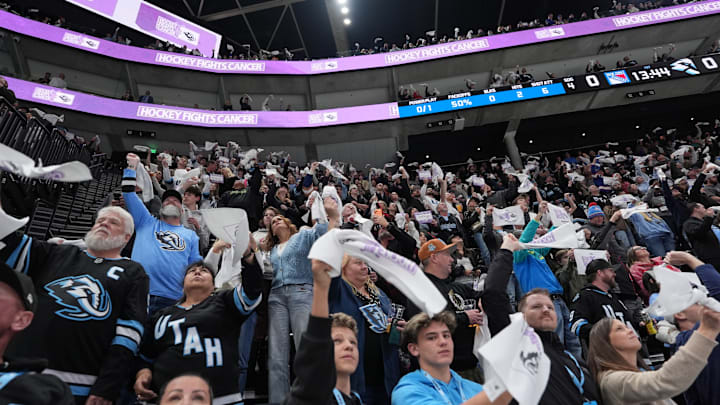
A major contributor to growing viewership in professional leagues is expansion. In recent years, expansion or reconstruction has been prominent in the big 4 leagues, and beyond.
The Toronto Tempo are preparing to enter the WNBA in 2026. The Professional Women's Hockey League is pushing west with new teams in Vancouver and Seattle, joining play for the 2025 season . And in the NHL, the league’s newest franchise — now branded the Utah Mammoth — emerged in 2024 after the restructuring of the Arizona Coyotes. Expansion makes headlines because it’s exciting with new logos to rep, new arenas to visit, and new rivalries to cheer for or against. But behind the spectacle is a far more calculated question — what actually makes a hockey market work?

The NHL’s growth has never been random. When the Coyotes’ franchise was deactivated and its assets sold to establish the Utah Hockey Club, the decision was framed as strategic and data-driven, centered on infrastructure, market size, and long-term viability. As of 2026, the league sits at 32 teams, evenly divided with 16 in each conference and eight per division. Symmetry matters. Teams play division opponents three to four times per season, conference rivals outside their division three times, and teams from the opposite conference twice. The playoff format, allowing top three in each division plus two wild cards per conference, is now balanced, with no conference gaining an easier path. Structurally, the NHL is balanced and aligned, but structural balance only works if the markets themselves are strong.
Population is typically the first metric examined when determining a location for a franchise. A large metropolitan area naturally generates buzz. More people mean a larger potential fan base, a wider media reach, and greater organic conversation around the team. In theory, dropping a franchise into a booming city creates automatic momentum. Yet hockey history shows that population alone does not always guarantee success. The Winnipeg Jets operate in the NHL's smallest metropolitan market of roughly 850,000 people but consistently demonstrate how culture can outweigh census numbers. Winnipeg is not just a home to a team, but rather a hockey city. The sport is a major part of its identity. Smaller markets such as the Buffalo Sabres, Ottawa Senators, and Columbus Blue Jackets face similar realities: sustainability depends less on sheer size and more on depth of fan devotion.
Demand is equally as critical. A city’s appetite for a professional franchise cannot be assumed. In markets already supporting NBA, NFL, MLB, or MLS teams, competition for attention and disposable income is intense. As of 2024, there were 51 cities across North America with major league teams, with just 12 of them home to one franchise. Winter sports compete directly with basketball seasons; spring playoff pushes collide with baseball openers. Some cities thrive as multi-sport hubs, where professional teams coexist and feed off one another’s momentum. Others struggle with oversaturation. For a hockey market to succeed, it must either face limited competition for winter sports dollars or exist within a sports culture robust enough to sustain multiple major league identities. Utah’s appeal rested partly in this space of a fan base eager for top-tier professional hockey and an ownership structure prepared to capitalize on it.
Infrastructure may be the least exciting element of expansion, but it is often the most decisive. An NHL-ready arena, accessible location, stable lease agreements, and municipal cooperation are all important prerequisites. Building a new facility can cost upwards of a billion dollars, and without political and financial alignment, even enthusiastic markets fall flat. Utah’s advantage was not just theoretical fan interest, it was readiness to accommodate a venue and team of NHL nature. The physical space to host the league already existed, reducing uncertainty and accelerating integration.

Then there is the corporate groundwork. Modern franchises rely on more than ticket sales. Naming rights, luxury suites, sponsorship deals, and local advertising partnerships form a financial motor beyond the ice. A strong business community signals long-term stability. Without it, even passionate fan bases can struggle to sustain profitability. Commissioner Gary Bettman has frequently emphasized the importance of determining what is considered a strong market with confidence, rather than impulse. The league’s measured growth suggests that economic durability outweighs geographic placement.
Ultimately, the qualities of a good NHL market extend beyond spreadsheets. Population creates potential, while demand determines urgency. Infrastructure enables execution, and corporate backing ensures survival. But culture is what transforms a franchise from a tenant into a pillar of the community. Winnipeg proves small markets can thrive when hockey is woven into daily life. Utah represents a calculated wager on emerging passion supported by strong fundamentals. And as expansion conversations continue across leagues, from the NHL to women’s professional sports, one principle remains constant: a successful hockey market is not simply a place with enough people. It is a place where the game matters.
 Add us as a preferred source on Google