

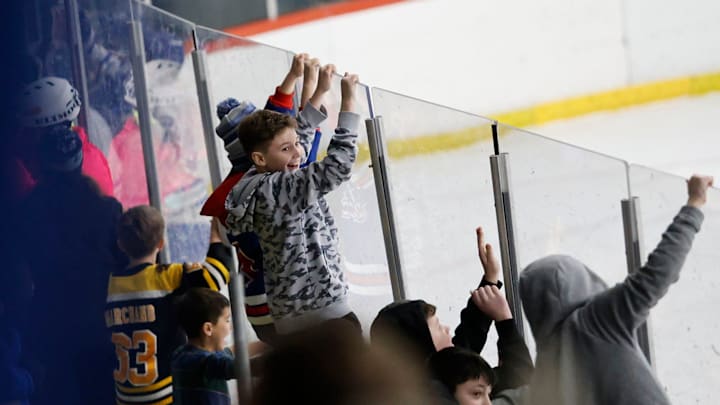
The streetlights are still humming when the alarm goes off before sunrise. A child pulls on a toque over damp hair lingering from yesterday’s practice, while a hockey bag gets lifted into the back of the car. All over Canada, the ice inside the rink is bright, smooth, and freshly flooded. It stays consistent and easy to predict.
But what it costs to get there is a different story.
For many Canadian families, hockey is nearly a right of passage and begins simply enough. A child learns to skate, joins a local house league team, and quickly falls in love with the routine of weekends at the arena. Then comes the registration forms that arrive in late summer, carrying the biggest financial hurdle of the season. In Ontario, the Ontario Minor Hockey Association reports that recreational hockey registration fees average around $668.75 for a season that typically runs 20 to 24 weeks.
At first glance, the number may seem higher than other youth sports, such as baseball, soccer, and lacrosse. The OMHA points out that when broken down by activity program, which equals about 40 total sessions of practices and games, the cost per ice time is roughly $16. When compared to shorter community programs like a 10-week soccer season, hockey appears competitively priced.
But the registration fee is rarely the invoice that families remember.
Before the puck drops, a parent must drain their pockets to outfit their child from head to toe. Skates, a helmet, shoulder pads, elbow pads, shin guards, gloves, hockey pants, neck guard, a stick, a mouth guard and a bag large enough to hold it all, is just the beginning. Even modest equipment purchases can reach $600 to $1,500 in the first year alone. Within a season or two, children outgrow their skates, sticks snap, and gloves wear thin.
By the time the year is over, many house-league families have spent anywhere from $1,500 to $3,000.
Even the smaller items add up. Beginning in the 2025–26 season, participants registered under Hockey Canada are reported to pay $41.41 in annual service fees, which include insurance and national development programs. The increase, that equals $11.68 more than the previous fee structure, is the first significant adjustment in over two decades.
None of these numbers are overwhelming, but hockey rarely exists in isolation. It’s hard to play without the proper equipment, it's hard to be good without coaching, and it’s hard to improve without growing and moving through the leagues.
Across North America, youth sports are becoming more expensive. Research from the Aspen Institute’s Project Play initiative found that youth sports costs in the United States have risen 46 percent since 2019, according to its State of Play 2025 report. Participation has bounced back since the pandemic drop off. This equals 55.4 per cent of youth aged six to 17 who played organized sports in 2023. But affordability remains one of the biggest barriers for families across the country to get their child into the sport.
The report also highlights a growing divide in the sport community. Children from wealthier households tend to play their primary sport more often and are far more likely to participate in travel teams and private training programs, because they can afford to do so.
In hockey, that divide often begins the moment a child moves beyond any house league, and can also decide if they make that transition at all..
Rep hockey, including AA, AAA, and elite travel teams, brings faster play, more competition and bigger ambitions. It also brings a dramatically different financial reality for families. According to a 2023 survey by Hockey Canada, the average annual cost to play minor hockey at the competitive level surpassed $5,000 per player, with some families paying upwards of $10,000. Registration alone can jump into the $2,000 to $8,000 range depending on the program and level. Those fees may include additional ice time, coaching, and tournament entry, but they rarely cover the full season.
A sample from the Kingston Area Minor Hockey Association showed a base rep fee of $2,650 per player, a fee that does not include tournaments, buses or any team related expenses during the season.
Travel quickly becomes one of the biggest and most unpredictable expenses. Competitive teams often play tournaments across the province, country or even across the border in the United States. Families book flights, hotels, rental cars, gas, and meals while balancing school calendars and taking time off from work. While it’s unfair to guess the average cost of a single out-of-town tournament due to the unknown of it all, a family can easily expect the cost to be a pretty penny.
In addition to travel, equipment costs also evolve as the competition rises. High-performance skates can exceed $1,000. Elite-level sticks can cost $300 or more and break regularly. Competitive players may go through a dozen or more sticks in a season. Protective gear needs to be replaced more frequently, and often gets upgraded as the game becomes faster, more physical, and played regularly.
Annual equipment costs at the elite level can climb into the $3,000 to $6,000 range.
To stay competitive, many players continue their practice outside of the winter season. Add on spring teams, summer camps, power-skating sessions and strength training programs, some development camps can run hundreds of dollars per week. Private skills coaches often charge by the hour.
Off-ice training alone can add another couple hundred dollars annually.
By the time everything is accounted for, an elite minor hockey season can cost upwards of $10,000 for a single player. Over the course of a minor hockey career, families may invest well over this amount while pursuing an opportunity that might lead to junior hockey, NCAA opportunities or, for very few, professional dreams.
Hockey organizations often emphasize the value that comes with those costs. The OMHA says that ice rental remains the largest expense in the sport, while indoor facilities naturally drive prices higher than field or court sports. Many associations attempt to keep registration fees manageable for Canadian families. Financial assistance initiatives like Jumpstart and KidSport aim to reduce barriers where possible.
For many families, the return on investment isn’t measured in dollars spent, but rather lessons about teamwork and locker room friendships.
Still, the financial reality for Canadians is becoming harder to ignore. According to a 2024 report by RBC, parents invest an average of $4,478 annually, totaling $53,735 by the time their child reaches 16 on basic hockey fees required to step foot on the ice.
As youth sports systems grow more privatized, a trend noted in the Aspen Institute’s research, elite development continues to mimic that of professional pathways.
The ice remains open to everyone, but the pathway forward often depends on what families can afford to spend along the way.
For many Canadian families, the dream of playing hockey remains strong, but pursuing it has never come at a higher price.
 Add us as a preferred source on Google