

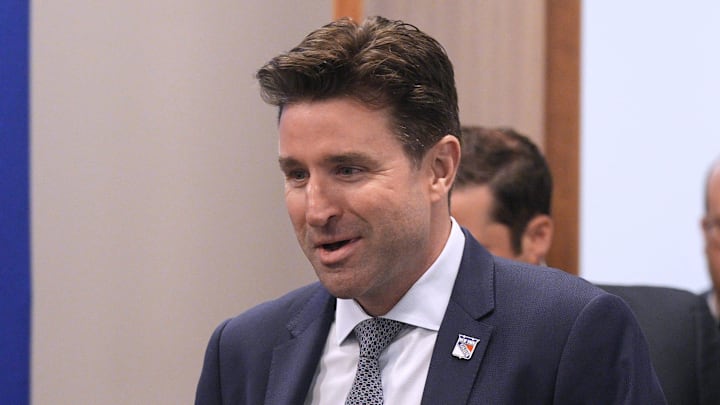
The New York Rangers
While it could be argued that the Toronto Maple Leafs should also grace the top of this list, the Leafs edged the Rangers by at least acquiring a first-round pick for a bottom-six center while the Rangers couldn’t acquire a first or even second-round pick for their franchise acquisition in Artemi Panarin.
Of course there is a reason and a whole storyline for why Ken Holland and the LA Kings were able to bank rob the Rangers, especially with Panarin reportedly coercing the Rangers to trade him to LA, but this trade does not excuse Chris Drury from failing to acquire assets for other experienced players on this roster to fuel the rebuild. While Drury believes that their process is more attuned to a retool, the distinction is irrelevant, as the Rangers are simply in the swamp of the NHL, in which they are treading water between said retool and rebuild.
They have experienced and veteran players such as Vincent Trocheck and Vladislav Gavrikov to accompany franchise players in Igor Shesterkin and Adam Fox, as well as a former first overall pick in Alexis Lafrenière sprinkled into the lineup. Nevertheless, they have inconsistent players in Mika Zibanijad (who is having a resurgent year) and JT Miller, who hasn’t exactly been the pillar of leadership in the Rangers’ locker room.
While the Rangers made a move or two (literally), the New York Rangers and general manager Chris Drury have not done nearly enough to restock their resources to prepare for the upcoming rebuild/retool. There are sparks of hope in Will Cuylle and Gabe Perrault, who are emerging as the future of the Rangers’ offense. But for now, the Rangers are under a period of uncertainty and troubled waters with Chris Drury at the helm of one of the oldest franchises in the NHL.
The Buffalo Sabres
While the Buffalo Sabres have had a remarkable season, the Sabres have had a drama-filled trade deadline and not in the way they would have wanted. With the Sabres being unable to convince star and veteran defenseman Colton Parayko to waive his no-trade clause, the Sabres have likely received a wake-up call about the reality surrounding not just their team but their franchise as a whole.
While the Sabres are in the top ten of the NHL standings, there is a certain stench surrounding the franchise that takes time to disinfect. With the numerous cases of incompetence and failure surrounding Buffalo’s management in the past, especially with ownership and Jarmo Kekäläinen’s predecessor Kevyn Adams, it will take some time for players across the league to gain some faith or even desire to shift their attention to upstate New York. From the Palm Tree comment to the Jack Eichel affair, the Sabres will likely need more consistent success in order for players to be convinced that they could have a stable career wearing a Sabres uniform.
Now, this segment isn’t meant to take away the magic of the season the Sabres are having. Kekäläinen, after the Parayko debacle, proactively shifted to acquiring Winnipeg’s defensemen Luke Schenn and Logan Stanley, two enormous and experienced defensemen who could make Buffalo’s blue line even more terrifying. The last acquisition the Sabres made was trading for New York Rangers’ fourth-line center Sam Carrick, who will be resuming his bottom-six duties and is looking like a decent fit so far. But the issue with the Sabres isn’t only trading for players; it's acquiring them and making sure that they believe in the franchise enough that they can see themselves contributing to its success and future.
The Carolina Hurricanes/Minnesota Wild
It might be strange to group these two teams together, but they are basically a mirror reflection of one another, with one team having an edge in goaltending. Both teams were known for their tandems of superstars, competent defenses, and horrendous center depth. While it could be argued that the Minnesota Wild acquired a franchise talent months before the trade deadline in Quinn Hughes, it is undeniable that they have failed to address one of their biggest needs in a second-line center. In fact, it's so similar to the Mikko Rantanen trade from last year, in which the Hurricanes opted to make the flashy trade instead of addressing a consistent weakness in acquiring a top-six center.
Both teams are currently manning a center core by committee, with Logan Stankoven, a winger, manning Carolina’s second-line center role and Joel Eriksson Ek as Minnesota’s answer at second-line center with Ryan Hartman taking over the first line. At this year’s deadline, both teams decided to beef up their bottom-six rather than pulling the trigger on the very lackluster center market where they were both involved in the Vincent Trocheck proceedings. Carolina instead opted to trade for Nick Deslauriers, who will likely act as the team's thirteenth forward. The Wild proceeded to trade for winger Bobby Brink in exchange for defenseman David Jiricek while also acquiring bottom sixers Michael McCarron and Nick Foligno.
With Vincent Trocheck remaining in New York after general manager Chris Drury’s steep demands went unmatched, both teams prepare to embark on their respective playoff runs with the cards they’ve been dealt with. The Minnesota Wild prepare to undertake a playoff run with very poor center depth but a terrifying defense and stacked wings on both sides. The Carolina Hurricanes are still equipped with competent forward depth and a very well-coached defense to make up for their weaknesses down the middle and in net. However, should they fall in the playoffs, it’ll most certainly be due to the staggering inconsistencies and weaknesses at the center position that they have continuously failed to address, instead opting for a more flashy acquisition or, in Carolina's case, nothing at all.
 Add us as a preferred source on Google