

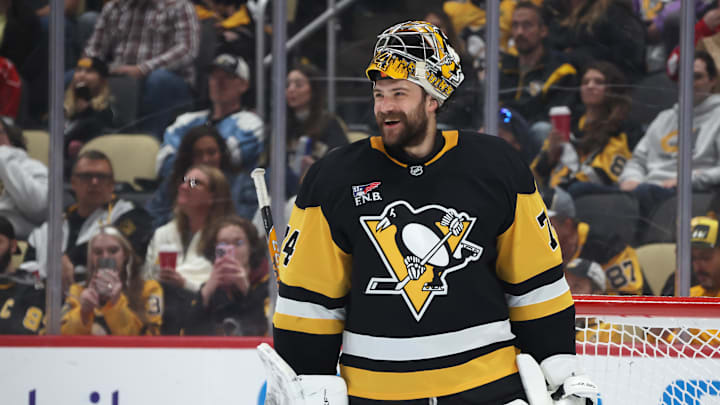
So yes, of course there is at least one buyer that is listed as a winner, and no, it's not the Colorado Avalanche. Teams like the Avalanche are an honorable mention, as they are dependent on their Stanley Cup aspirations. Most buyers take on the "buyer's beware" warning when they make an acquisition from a seller, unless they are the Pittsburgh Penguins, who have been open for business since before the Olympic break. The Penguins are the only exception this year, as they also sold some expensive and aging contracts while also buying younger players to fuel their youth movement for the future.
The Chicago Blackhawks
Let’s be honest here, the Blackhawks made out like bandits during this edition of the NHL trade deadline. Receiving a bounty in draft picks for a bottom-six specialist in Jason Dickinson, a disgruntled prospect in Colton Dach, and a right-handed middle-pairing defenseman in Connor Murphy is a decent haul. Sure they tacked on another brutal contract in Andrew Mangiapane, but the Blackhawks still need short-term contract placeholders as they continue to put the finishing touches on their rebuild.
In retrospect the trade wasn’t so bad for the Oilers, but considering the desperate situation that Edmonton was in (before the Draisaitl injury; now it's even worse) due to essentially being coerced into maximizing Connor McDavid’s limited remaining tenure with the franchise, this trade is still a massive win for the Blackhawks. But let's get something straight and ask a very important question(s): What is the plan for Chicago? Will this be their last deadline within the seller class?
The hauls they are receiving for the bottom six/pairing mercenaries are great, but how will they use these assets to maximize Connor Bedard’s remaining tenure as they begin the process of incentivizing him to commit to their future? It's easy to say that Chicago needs one more “blue chip prospect," but what about some actual help on the top line or the top pairing?
While it could be argued that Chicago has wasted Connor Bedard’s talent in their never-ending rebuild, it's time to consider that maybe General Manager Kyle Davidson is ready for Chicago to take an aggressive next step towards contending. If not, then negotiations with Connor Bedard's camp will be an up-hill battle to ensure that he is apart of Chicago's Stanley Cup aspirations.
The St. Louis Blues
The Blues had a very lucrative deadline, and while it could be argued that they missed out on securing bounties for their franchise players in Robert Thomas and Jordan Kyrou, there is an argument to be made that maybe it wasn’t the utmost necessity. St. Louis instead opted to trade defenseman Justin Faulk to Detroit and their longtime captain Brayden Schenn to the New York Islanders.
These two veteran players fetched them quite a ransom, in which both trades involved a first-round pick being received. Their former captain helped them acquire a very late first-round (Colorado’s first-round pick from the Brock Nelson trade) and third-round picks in this year’s draft, an experienced player in Jonathan Drouin, and a decent goalie prospect in Marcus Gildof.
Justin Faulk resulted in the Blues acquiring a similar bounty in Detroit’s first- and third-round picks for this year’s draft, an intriguing prospect in Dmitri Buchelnikov, and an experienced but well-traveled defenseman in Justin Holl. What makes that trade even more interesting is that Detroit gave up their own first-round pick, compared to the Islanders, who gave up a Stanley Cup contender’s first-round pick, in which they are currently fighting for their playoff lives.
The Blues did a decent job at this year’s deadline. They began the process of eliminating a lot of excess and aging contracts off their books in preparation for retooling their roster around their younger and thriving players in Jimmy Snuggerud, Dalibor Dvorsky, the already established dynamic duo of Robert Thomas and Jordan Kyrou, and of course whoever they might draft should they merit a top-five pick in this year’s draft.
The Blues already have an experienced but well-balanced lineup; it’ll be interesting to see what they should do in this year's offseason to plug some of the holes in their lineup, such as acquiring more stable goaltending, a dynamic offensive defenseman, and a quality second-line center to shadow Robert Thomas (since Pavel Buchnevich has currently assumed second-line center duties).
The Pittsburgh Penguins
With the NHL Trade Deadline being a sellers' market for the past two years, it's easy to label almost every seller a winner. The case of the Pittsburgh Penguins is a much different scenario this year, as their prospects and veteran signings from the past free agency period have morphed into a competent force of nature.
The Penguins made some interesting acquisitions, with a few being before the trade deadline. The first was Egor Chinakov from the Columbus Blue Jackets. The formerly disgruntled winger has seemingly regained his love for the game through his 12 goals and 12 assists for 24 points in 31 games.
Another trade before the deadline resulted in Tristan Jarry being sent to the Edmonton Oilers in exchange for Stuart Skinner, Brett Kulak, and a 2029 second-round pick. Kulak would then subsequently be traded to the Colorado Avalanche for Samuel Girard and a 2028 second round pick. At the trade deadline, Kyle Dubas weaponized his arsenal of draft picks to acquire Elmer Soderblom from the Detroit Red Wings for a 2026 third-round pick.
While some of the trades aren’t having an immediate impact, besides Chinakov, general manager Kyle Dubas should be commended for stocking up on draft picks and getting rid of excess contracts such as Tristan Jarry’s.
What’s even more fascinating is the players that he is taking on are quality and experienced players such as Stanley Cup champion Samuel Girard and playoff veteran Stuart Skinner. While Skinner was the perennial punching bag in Edmonton, and sure, he isn't exactly putting up decent numbers for Pittsburgh currently during the regular season, should the Penguins clinch the postseason, he will no doubt be instrumental in their playoff success.
 Add us as a preferred source on Google