

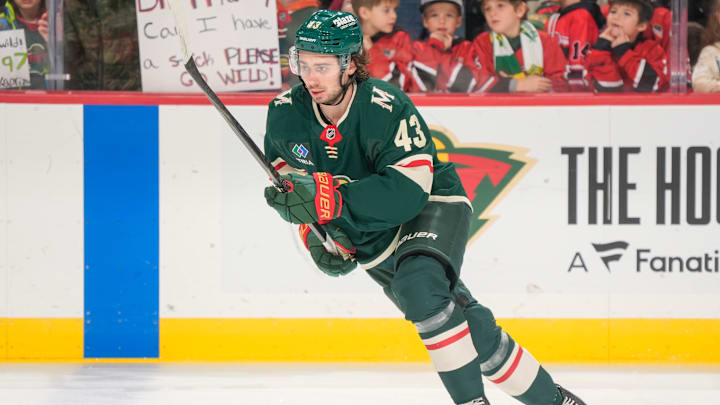
There were many rumblings regarding Quinn Hughes' future. Will he join a contender, will he join his brothers in New Jersey, or will he stay in Vancouver? The answer: Neither? It isn't to say that the Minnesota Wild are not a team on the rise, but they are arguably (currently) not a contender. A perfect illustration can be seen after closely examining their center depth, especially after the trade which saw a promising top-six center in Marco Rossi being sent to the Canucks. But with the trade in the books and its effects having been given time to marinate, it's time to take a look at who benefits and how so.
The Short Term: The Minnesota Wild
While it could be argued that Quinn Hughes' arrival signals the inception of Minnesota's Stanley Cup aspirations, it could be argued that the Wild are still a few pieces away from becoming a true Cup contender, especially considering their neighboring opponents in their division.
After packaging their second-line center, Marco Rossi, their most promising prospect in Zeev Buium, and Liam Ohgren, the Wild's trade package symbolizes a very fascinating exchange. To acquire a generational talent in Quinn Hughes, the Wild had to sacrifice a huge piece of their top six in Rossi, the heir to their defense in Zeev Buium, and a promising middle-six forward in Liam Ohgren. While Ohgren's numbers weren't spectacular, the young forward had the potential of being a young staple to Minnesota's forward group and providing some youthful stability to an offensive rush that is held together by aging veterans.
Now, what does Quinn Hughes bring to the table? Well, besides being one of the best defensemen of his generation, Hughes' addition provides Minnesota a chance to assemble one of the best defensive pairings with Quinn Hughes on the left and Brock Faber on his right.
There is no doubt that the Minnesota Wild and their acquisition of Quinn Hughes unlocks a multitude of opportunities. However, the package they gave up does highlight some of the glaring holes within their lineup. For example, their center depth is very glaring with the absence of Marco Rossi, as Ryan Hartman, the team's usual third-line center, has assumed the first-line center role. Joel Eriksson-Ek, the former answer to the first-line center role, has likely withdrawn to a middle-six role, as he has been rotated in and out of the top six. Eriksson Ek, a center who has only achieved a 30-goal season once in his career, is a solid top-six center but is clearly not the first-line leader that the Wild have been hoping for.
With the Quinn Hughes trade, Minnesota and their fans expected a young Danill Yurov to step up and claim a top-six role to expedite his development for the future of their top-six. But ever since the trade, his lackluster production has relegated him to a third-line role. Minnesota could potentially find another trade partner in their quest to bring in an experienced top-six center, but currently the Quinn Hughes trade has only highlighted their gaping hole down the middle of their roster, which could pose as a major obstacle in their Stanley Cup aspirations.
Long Term: Vancouver Canucks
It should be noted that the Quinn Hughes situation seemed almost apocalyptic for the Vancouver Canucks and their management. With teams like the New Jersey Devils threatening to bide their time and await his exodus from Vancouver during free agency in two years or other teams lining up with mediocre packages due to the rumors of Hughes' discontent with the franchise and his Vancouver teammates, the Canucks turned a depressing situation into a light at the end of a very dark tunnel.
It was reported that the Canucks were requesting a young center and defenseman, an additional prospect, and a first-round pick for their generational defenseman. Minnesota easily answered that call and handed Vancouver everything they could ever want on their wish list.
Starting off with Marco Rossi, the Austrian forward was already a staple on Minnesota's top six and would alternate with Joel Eriksson Ek regarding first-line duties. Rossi has already achieved back-to-back 20-plus-goal seasons and continues to develop alongside teammates that can contribute to his success, which he will find alongside Brock Boeser and Jake DeBrusk for the time being. As a result of the trade, Vancouver acquired a top-six center for their future who will likely shadow Elias Pettersson to produce a top six center one-two punch.
Zeev Buium was regarded as one of the best defensive prospects of the last decade. Drafted 12th overall in the 2024 NHL Draft, Buium has had an excellent start to his first year in the NHL by posting 3 goals and 11 assists for 14 points in 31 games. The young defenseman produced these numbers while inhabiting a crowded blue line on the Minnesota Wild.
After swapping teams with Quinn Hughes, Buium finds himself on a team desperately needing a blue line stimulant, in which Buium has already delivered 1 goal and 2 assists for 3 points in his first 5 games as a Canuck (in which two of those points came in his first ever game since being traded). Buium, who went from an excellent prospect to a potential replacement for one of the best defensemen of this generation, will continue to develop into a beacon of hope for the future of the Vancouver Canucks and their blue line.
Liam Ohgren, while his numbers are not exceptional, was a significant piece of Minnesota's youth movement in the bottom six. In his first 18 games with the Wild this year, Ohgren posted 0 points, which should be a massive cause for concern. However, similar to Buium, Ohgren was a rotating piece in a crowded Minnesota bottom six filled with experienced veterans and developed players looking to mark their territory in the NHL, which doesn't leave much sympathy for a young player looking to further his growth as a future NHLer. After being traded to the Vancouver Canucks, Ohgren has 2 goals and 1 assist in his first 5 games as a Canuck, which should spark some hope in his quest to become an NHLer and for Vancouver to hopefully develop a young middle six forward.
The Bottom Line
Let's face it, there really is no real loser in this trade. Many readers or NHL critics may say Tom Fitzgerald and the New Jersey Devils are the true losers of this trade, as they are technically the team on the outside looking in on this transaction, especially since they were the favorites to land the brother of both Luke and Jack Hughes. But in reality, the Devils can bide their time and prepare a hero's welcome for Quinn Hughes if the Minnesota Wild fail to extend him and he decides to walk in free agency.
But alas, the team that has clearly won the trade has been the Vancouver Canucks. Unless the Minnesota Wild win the Stanley Cup with Quinn Hughes or at least extend him to a long-term deal, the Vancouver Canucks have secured a plethora of assets to strategize away from an imminent rebuild into a retool. Quinn Hughes reportedly mentioned that he was not looking to be a part of the Vancouver Canucks should they enter a rebuild. But now, the Quinn Hughes trade has transformed into some delicious irony, as it likely helped Vancouver avoid a grueling rebuild through their acquisition of everything on their wish list.
Time will tell who has truly won this trade. Even with the Minneosta Wild looking lacklsuter down the middle considering the center depth, they still managed to acuqire an incredible piece in Quinn Hughes, and generational defenseman do not grow on trees. However, while Patrick Allvin does receive devastating forms of criticism at times, to say that Allvin's negotiations didn't potentially save the Vancouver Canucks from an uncertain future is a gross understatement.
 Add us as a preferred source on Google